What Are the First Symptoms of Chlamydia?

Last updated: September 4, 2026
Quick Answer
Most people with chlamydia notice nothing at all in the first days or weeks. When early symptoms do show up, they are usually mild: a change in discharge, a burning feeling when you pee, or a dull ache low in the belly or pelvis. These signs overlap heavily with other infections, so a test is the only way to know what is actually causing them.
Key Takeaways
- Chlamydia often causes no symptoms in the first days or weeks, in either men or women.
- When symptoms do appear, they tend to be mild and easy to mistake for a UTI or normal irritation.
- Timing varies, but early signs are most often reported roughly one to three weeks after exposure, if they show up at all.
- Symptoms overlap between chlamydia, gonorrhea, and urinary tract infections, only a test can tell them apart.
- Throat, eye, and rectal chlamydia can each look different from genital infection, and are often mild or silent too.
- Chlamydia does not reliably go away on its own and can lead to complications if left untreated.
- Chlamydia is treatable, and your clinic will tell you what applies to the test and treatment they use.
- Home tests can be a reasonable first step, but accuracy varies by brand and by how the sample is collected.
What Are the First Symptoms of Chlamydia?
The first symptoms of chlamydia, when they appear, are usually a change in discharge, a burning feeling when urinating, or mild discomfort in the lower abdomen or pelvis. Many people who have chlamydia notice nothing distinct at all, which is one reason the infection spreads quietly.
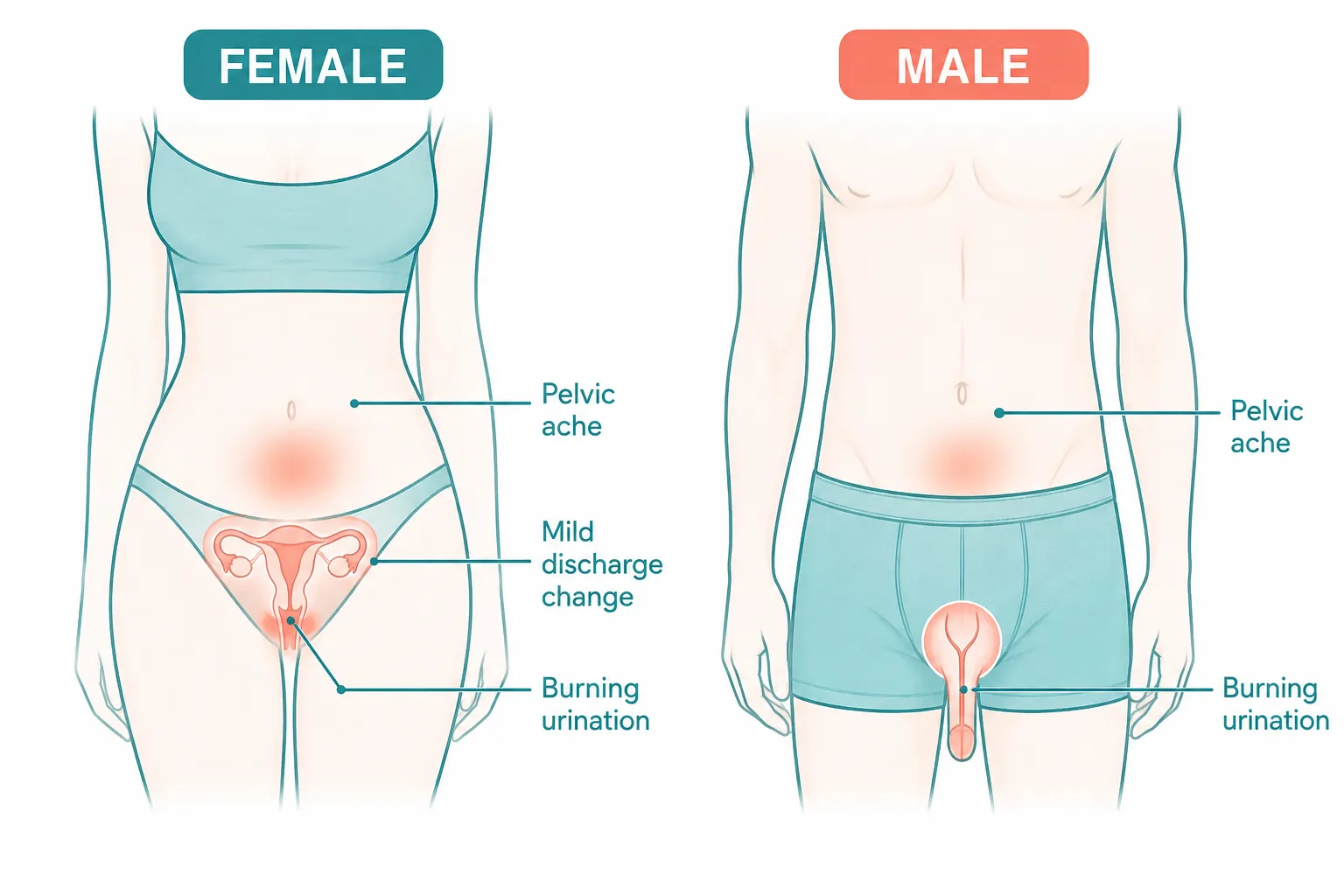
In women, early signs can include a slightly different vaginal discharge, mild pelvic discomfort, or spotting between periods. These changes are often small enough to be written off as normal cycle variation.
In men, the more commonly reported early sign is discharge from the penis, sometimes with burning during urination or mild discomfort in one testicle. Not everyone gets even this much.
The overlap matters: because these symptoms are so mild and so common to several conditions, a description alone cannot tell you what is going on. Only a test can tell them apart. If you want to read what this looked like for other people, the chlamydia forum for help and support has firsthand accounts worth reading.
How Long After Exposure Do Chlamydia Symptoms Show Up?
If symptoms appear, people most often report them roughly one to three weeks after exposure. That is a general pattern, not a guarantee, and some people notice something sooner or much later, or never.
There is also a separate question of when a test becomes reliable, called the window period. This is not the same thing as when symptoms might appear, and it varies by the type of test used and by country. Ask the clinic that ran the test what window applies to their specific test rather than relying on a number from an article.
If you had a symptom flare and then it eased off, that does not mean the infection cleared. People have described exactly this pattern of symptoms coming back weeks after treatment, which is worth reading if your timeline feels confusing.
Can You Have Chlamydia With No Symptoms?
Yes. A large share of chlamydia infections cause no noticeable symptoms in either men or women, sometimes for months. This is the main reason routine screening exists in many countries, rather than waiting for symptoms to prompt testing.
This silent pattern is not unusual and it is not a sign that something is medically wrong beyond the infection itself. One member of the community described getting a positive chlamydia result with no symptoms at all, and that thread has replies from others who went through the same thing.
Decision rule: if you have had a new or unprotected exposure, get tested regardless of whether you feel anything. Waiting for a symptom to show up is not a reliable strategy.
Do Chlamydia Symptoms Look Different in the Throat, Eyes, or Rectum?
Yes, chlamydia can infect the throat, eyes, or rectum, and each site tends to produce its own pattern, often mild or absent. Genital symptoms do not have to be present for one of these other sites to be infected.
- Throat (oropharyngeal): often no symptoms at all, or something that feels like a mild, ordinary sore throat.
- Eyes (conjunctival): redness, irritation, and discharge, similar in appearance to common conjunctivitis.
- Rectum: mild pain, discharge, or occasional bleeding, though many rectal infections cause nothing noticeable.
- Genital: the discharge and urinary symptoms described earlier.
Not all chlamydia infections cause discharge. A rectal or throat infection can be entirely silent, and even genital infections sometimes produce no discharge at all. Exposure site matters for which swab or sample the clinic will want to take, so tell them honestly where exposure happened. Someone who tested positive at the throat with zero symptoms and felt completely blindsided has shared that experience on the forum.
How Do You Tell Chlamydia Apart From Gonorrhea or a UTI?
You cannot reliably tell chlamydia, gonorrhea, and a urinary tract infection apart by symptoms alone, because they overlap so closely. Burning urination, discharge, and pelvic discomfort show up across all three.
| Feature | Chlamydia | Gonorrhea | UTI |
|---|---|---|---|
| Discharge | Sometimes, often mild | Sometimes, can be more noticeable | Usually none |
| Burning urination | Common | Common | Common |
| Pelvic or lower abdomen pain | Possible | Possible | Possible |
| Fever | Uncommon early on | Uncommon early on | Possible if kidneys involved |
A UTI is usually diagnosed with a urine culture, while chlamydia and gonorrhea are usually checked with a NAAT on a urine sample or a swab. This varies by clinic and by country, so ask the clinic that ran the test which one applies to your result. The only way to know which of these you have, or whether you have more than one, is testing.
What Should You Do if You Think You Have Chlamydia?
Get tested. That is the direct answer, and it applies whether or not you have any symptom at all, and whether or not this is your first scare.
- Contact a sexual health clinic, a GP, or a testing service near you.
- Expect a urine sample or a swab, depending on the exposure site involved.
- Ask about partner notification so anyone who needs testing gets the chance.
- Avoid sex until you have your result and any treatment is complete.
Home chlamydia tests can be a useful first step for people who cannot get to a clinic quickly, but accuracy varies by brand and by how carefully the sample is collected. A positive home result should still be confirmed through a clinical pathway, and a negative one during a possible window period does not rule anything out. If a result comes back positive and you are unsure what happens next, others who were newly diagnosed and frightened have written about what the following days actually looked like.
Can Chlamydia Go Away on Its Own, and What Happens if It’s Not Treated?
Chlamydia does not reliably clear on its own, and leaving it untreated carries real risk of complications over time. It is a curable bacterial infection, but curable only means treatment works, not that it resolves without one.
Left untreated, chlamydia has been linked to complications including pelvic inflammatory disease in women and, in some cases, effects on fertility [1][2]. In men, untreated infection can occasionally lead to epididymitis, a painful inflammation of a structure near the testicle [5]. Newborns exposed during birth can develop conjunctivitis, often within the first couple of weeks of life [6].
Your clinic will tell you what applies to the treatment they use, and this is not something to start, stop, or adjust on your own. If symptoms return after treatment, that is worth reporting rather than assuming, since it could mean reinfection, a different infection, or something that needs a closer look. A thread on symptoms returning weeks after treatment covers how other people approached that exact situation.
Frequently Asked Questions
Can chlamydia symptoms come and go? Yes, mild symptoms can ease up and return, and that pattern does not mean the infection has cleared. Only a retest can confirm whether it is gone.
Can you retest too soon after treatment? Testing too early can give a result that does not reflect whether treatment worked, because of how tests detect the bacteria. Ask the clinic that ran your test what timing they recommend for a retest.
Does a negative test rule out chlamydia completely? Not always, especially if the test was taken very soon after exposure, during the window period. Your clinic can tell you whether a repeat test makes sense in your situation.
Can chlamydia affect both partners differently? Yes, one partner might have noticeable symptoms while the other has none, since chlamydia often causes no symptoms in either sex. This is exactly why partner notification and testing both partners matters, not just the one who noticed something.
Conclusion
The honest summary is this: early chlamydia symptoms, when they show up, are usually mild and easy to confuse with something else, and most infections show up with no symptoms at all. No description on this page or any other can tell you what is happening in your specific body. A urine sample or a swab at a sexual health clinic, checked with a NAAT, is the only reliable way to get an answer.
If you are waiting on a result or trying to make sense of an early symptom right now, you do not have to sit with it alone. People who have been through it are talking through their own timelines, results, and questions in the chlamydia forum for help and support, and you can share your experience or ask anonymously whenever you are ready.
References
[1] Index – https://www.cdc.gov/chlamydia/about/index.html [2] Stdfact Chlamydia Detailed – https://www.cdc.gov/std/chlamydia/stdfact-chlamydia-detailed.htm [3] Chlamydia – https://www.who.int/news-room/fact-sheets/detail/chlamydia [5] 4023 Chlamydia – https://my.clevelandclinic.org/health/diseases/4023-chlamydia [6] Cdc 11911 Ds1 – https://stacks.cdc.gov/view/cdc/11911/cdc_11911_DS1.pdf
One response to “What Are the First Symptoms of Chlamydia?”
Leave a Reply
You must be logged in to post a comment.
[…] What actually matters clinically is change: a new color, a new smell, a new amount, or discharge that shows up alongside pain or bleeding. If any of that applies to you, the honest next step is a swab or urine sample at a sexual health clinic, not trying to match your symptoms to a description online. For a broader look at how chlamydia tends to present, see what are the first symptoms of chlamydia. […]